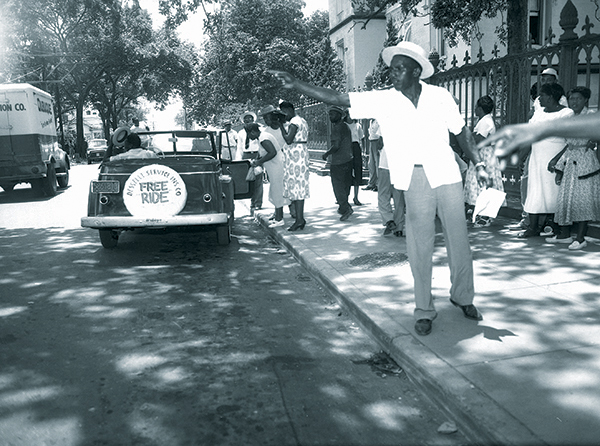
The 1953 Baton Rouge Bus Boycott · Photograph by Ernest Ritchie · Courtesy of 64 Parishes
In Loving Memory
of Baton Rouge, Louisiana
Foot Soldier of the 1953 Baton Rouge Bus Boycott · Secretary, Second Ward Voters League
Before Montgomery, before the marches the world remembers, there was Baton Rouge — and there was Hazel Freeman. She registered her neighbors to vote, drove the walking workers of a city that refused to ride in the back, and lived to tell the story so that her grandchildren, and ours, would never forget it.
The 1953 Baton Rouge Bus Boycott · Photograph by Ernest Ritchie · Courtesy of 64 Parishes
June 1953 · Baton Rouge, Louisiana

In June 1953, the Black community of Baton Rouge staged the nation’s first large-scale bus boycott against segregation — two and a half years before Montgomery.
For days, city buses rolled past empty stops. When a bus approached, waiting riders simply turned away. In their place rose an extraordinary act of organization: a free carpool system, assembled overnight, in which every neighbor who owned an automobile carried those who didn’t. Hazel Freeman was one of those drivers — picking people up and delivering them wherever they needed to go, so that no one would have to choose between dignity and a day’s wages.
Her work had begun long before the boycott. As Secretary of the Second Ward Voters League, Mrs. Freeman was part of the quiet army that registered Black Louisianians to vote in the years after World War II — house by house, name by name — building the political strength that made the boycott possible. She understood what the moment meant: that a people who could organize themselves could change a city, and that courage, once witnessed, spreads.
A weary housekeeper, Martha White, sits in an open “white” seat. The driver calls the police; the city holds its breath.
The state attorney general strikes down the seating ordinance. That night, leaders form the United Defense League and call the boycott.
Riders stay off the buses. Free carpools — Hazel Freeman among the drivers — move a whole community. The bus company nears collapse.
More than seven thousand people fill the municipal stadium, vowing to keep walking — a show of unity the South had never seen.
Her voice
In the award-winning Louisiana Public Broadcasting documentary Signpost to Freedom: The 1953 Baton Rouge Bus Boycott, Hazel Freeman appears as one of the boycott’s living witnesses — recounting the riders who turned their backs, the drivers who carried them, and the feeling of a people discovering their own power.
“Can you imagine that? Can you imagine that?”
— Hazel Freeman, on a people seeing the change they themselves were bringing
From Baton Rouge to Montgomery
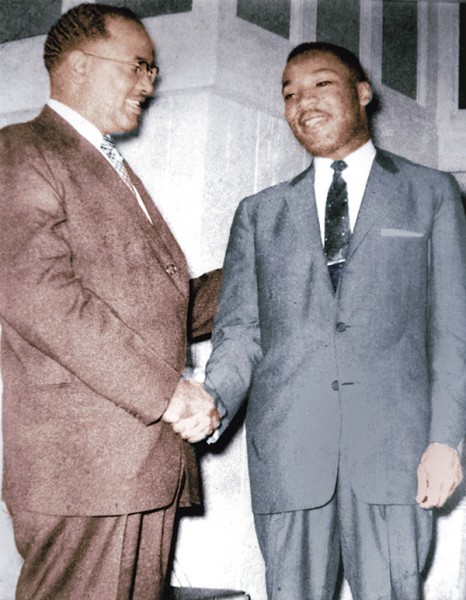
What Baton Rouge built in a week, the nation would build upon for a generation.
The boycott made headlines across the country, and its lessons traveled. Before launching the Montgomery Bus Boycott in 1955, Rev. Martin Luther King Jr. conferred with Rev. T. J. Jemison, the young Baton Rouge pastor who had led the United Defense League, and drew directly on the carpool system and mass-meeting model that Baton Rouge pioneered. Rosa Parks herself followed the events in Louisiana’s capital with awe.
Hazel Freeman stood among the ordinary, extraordinary people who proved it could be done. The movement that reshaped America rode, in part, on Baton Rouge automobiles — and one of them was hers.
A family’s tribute
The McClure Foundation’s work — restoring families, lifting young people, and pursuing justice — walks the road that Hazel Freeman helped pave. We honor her not only as a heroine of history, but as the matriarch whose faith, courage, and service shaped our family.
This memorial is lovingly dedicated by her granddaughter, Karla Pate McClure — the former Karla Lynn Pate of Baton Rouge — and her husband, Wesley Cornelious McClure, II.
The McClure Family · Washington, DC
Historical accounts, photographs, and recollections of Mrs. Freeman are drawn from 64 Parishes, a project of the Louisiana Endowment for the Humanities, and Louisiana Public Broadcasting. We are grateful for their stewardship of this history.